Richard D. Wyckoff and the origins of Smart Money
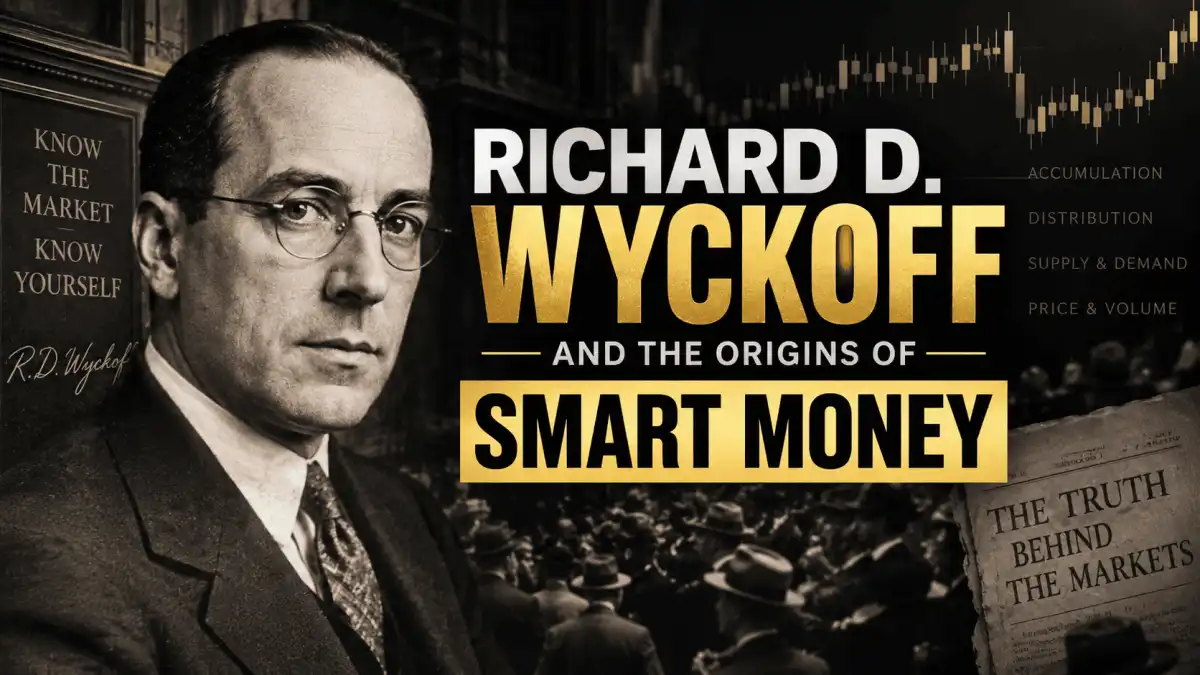
Long before the modern trading world began using the expression Smart Money Concepts, Richard D. Wyckoff was developing a method of market analysis based on a remarkably similar idea: that the movements visible on a price chart could be studied as the footprints of the large, informed interests operating behind the market. Wyckoff was a Wall Street trader, broker, publisher, and educator who began his career in the late nineteenth century and spent decades observing how successful operators accumulated and distributed positions. His work eventually became one of the foundational approaches to technical market analysis, and is still heavily referenced today. (Wyckoff Analytics)
Wyckoff's particular contribution was to shift attention away from simply asking where price was going and toward asking who was moving it, why they were moving it, and what their activity revealed about what was likely to happen next. Through his experience observing the market, he became convinced that large operators could not enter or exit substantial positions without leaving evidence in the market. Their transactions affected price and volume, and by carefully studying those relationships, he believed it was possible to infer the intentions of the dominant interests behind a move. In his own writings, Wyckoff described individual transactions as carrying evidence of purpose and argued that the fundamental law governing price changes was the relationship between supply and demand.
The central mental model he developed to explain this was the Composite Man. Wyckoff instructed his students to study the market as though all of the major operators were effectively one individual. In his Course in Stock Market Science and Technique, he wrote that all fluctuations in the market and in individual stocks should be studied as though they were the result of "one man's operations," and he called this hypothetical operator the Composite Man. The Composite Man was not meant to be a literal individual secretly controlling every price movement. It was a way of simplifying the market so that the trader could think about the actions of the largest and most influential interests as one coherent campaign.
Wyckoff's Composite Man was imagined as an extremely capable operator who understood the market better than the average member of the public. He accumulated positions when prices were advantageous, attempted to create the conditions necessary to move those positions higher, attracted public participation as the trend developed, distributed his holdings into that public demand, and eventually allowed the market to decline once the distribution process was complete. Wyckoff therefore viewed a major market movement not as a random sequence of candles, but as a campaign that could involve preparation, execution and completion.
Accumulation & Distribution
This led to one of the defining ideas in the Wyckoff Method: accumulation and distribution, whicch are terms I often use. A large operator could not simply purchase an enormous position in one transaction without driving the price against himself. Wyckoff explained that an operator attempting to acquire tens of thousands of shares would therefore need to accumulate gradually over days, weeks or even months, often while the market was weak, dull or depressed. The trading range that appeared on the chart was consequently not necessarily meaningless sideways movement, as it could represent the preparation for a much larger move. (studylib.net)
Once the operator had accumulated a sufficiently large position, the market could enter the markup phase. Rising prices and increasing public interest could bring additional buyers into the market, providing the liquidity needed for the large operator to begin distributing the position. Wyckoff therefore described a recurring market cycle consisting of accumulation, markup, distribution and markdown. The important point was that the visible trend was only one part of the process. The preparation that preceded it could contain information about the intentions of the dominant interests.
Wyckoff was particularly interested in the relationship between price and volume because he believed this relationship provided clues about the balance between supply and demand. A large amount of trading activity without a corresponding amount of price movement could tell a very different story from a large price movement accompanied by relatively little activity. Rather than treating volume as a standalone indicator, Wyckoff examined it in relation to the result produced by that volume. This became one of the foundations of his principle known as Effort versus Result: the market's effort could be compared with the actual result produced in price to help determine whether supply or demand was gaining control. (Ironclad Research)
Another important element of Wyckoff's thinking was his Law of Cause and Effect. In his framework, substantial price movements did not simply appear out of nowhere. A period of accumulation or distribution created a cause that could eventually produce a significant effect in the form of a subsequent advance or decline. The longer and more substantial the preparation, the greater the potential movement that could follow. This was one reason Wyckoff paid so much attention to what happened inside trading ranges rather than concentrating exclusively on the eventual breakout. (Ironclad Research)
Supply & Demand
His third major principle was the Law of Supply and Demand, which Wyckoff regarded as the fundamental force governing price. The task of the analyst was therefore to determine whether demand was overcoming supply or supply was overcoming demand, and to observe how that balance changed through time. His method combined this analysis with price and volume charts, including both traditional vertical bar charts and Point-and-Figure charts (available on the Pipnotic Edge charts), which he used to study the behavior of individual stocks and estimate the intentions of the dominant interests operating within them.
What makes Wyckoff particularly interesting historically is that he was not simply teaching traders to recognize patterns after they had happened. He wanted them to identify the preparation for a move. His writings repeatedly emphasize that important market movements take time to prepare and that, by studying the evidence left by large operators, traders could potentially recognize opportunities early enough to participate in the resulting move. The purpose of studying the Composite Man was therefore not merely to construct an explanation for an existing chart. It was to develop a framework for anticipating what the market might do next. (studylib.net)
Wyckoff's philosophy also contained a strong psychological dimension. He observed that large operators needed the participation of the public because they required liquidity in order to build and eventually unwind large positions. The public could therefore become part of the mechanism through which a large campaign was completed. A rising market could attract buyers after the major accumulation had already taken place, while enthusiasm near the top could provide the demand into which a large position could be distributed, and which still what brings 95% of speculators into a market. In Wyckoff's model, understanding the behavior of the crowd was therefore inseparable from understanding the behavior of the dominant operator.
Composite Man
This is why the Composite Man became such an important concept in Wyckoff's teaching. The trader was encouraged to stop looking at every price fluctuation as an isolated event and instead ask what kind of campaign the market appeared to be conducting. Was a large position being accumulated? Was supply being absorbed? Was the market being marked upward? Was distribution taking place? Was the market beginning to weaken after a long advance? The chart became, in effect, a record of the interaction between the dominant interests and the public.
Wyckoff's work dates from a market environment that was radically different from today's. There were no electronic markets, algorithmic execution systems, retail forex platforms or modern financial data feeds. He was studying stock markets through the tape, price charts, volume and direct observation of market operators. Yet his central proposition was remarkably straightforward: large participants cannot hide everything they do because their size forces them to leave traces in the market. The analyst's task is to learn how to recognize those traces. (Wiley Online Library)
What Wyckoff actually gave the trading world was arguably more significant than a label. He provided a complete philosophy for reading markets through the behavior of their largest participants. Instead of treating price as an isolated sequence of movements, he treated it as the visible consequence of an underlying struggle between supply and demand, shaped by the campaigns of powerful market interests. The trader's objective was to reconstruct those campaigns from the evidence contained in price, volume, time and market structure.
That is the historical importance of Wyckoff's work. More than a century ago, he was already teaching traders to look beyond the visible movement of price and ask what the dominant interests behind that movement were doing. His Composite Man was a conceptual model for the smart money of his era, and the Wyckoff Method was his attempt to teach ordinary traders how to recognize its footprints before the consequences of those actions became obvious.
References
Richard D. Wyckoff, The Richard D. Wyckoff Method of Trading and Investing in Stocks (1931), including the sections on the Composite Man, large operators, accumulation and the preparation of major market movements. (studylib.net)
Hank Pruden, Wyckoff: The Man, the Method, the Mystique, in The Three Skills of Top Trading (Wiley, 2012), discussing Wyckoff's analysis of the intentions of dominant market forces and the Composite Man framework. (Wiley Online Library)
Wyckoff Analytics, The Wyckoff Method: His Method and Story, which reproduces and contextualizes Wyckoff's Composite Man material and his three laws of market action. (Wyckoff Analytics)